
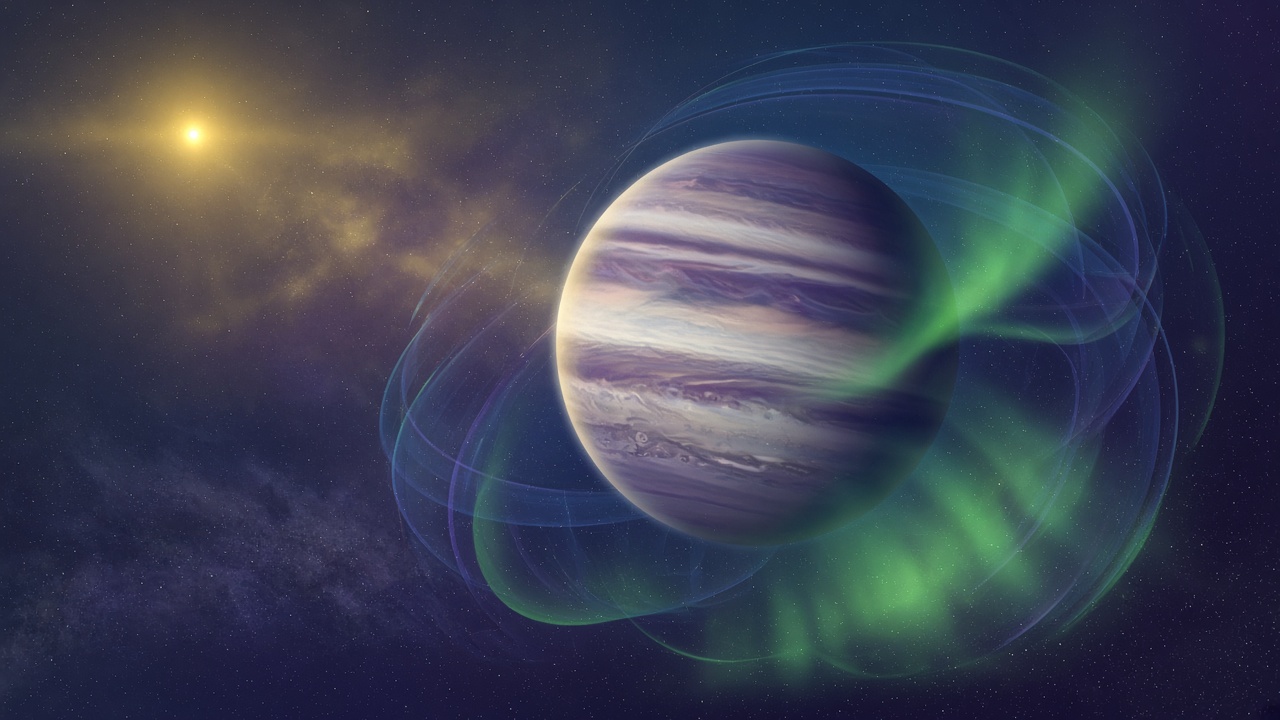
For years, astronomers have hunted radio whispers from planets beyond our solar system and kept coming up empty — or stuck arguing whether a blip belonged to the planet or its noisy star. That debate just got a clean answer.
Using South Africa’s MeerKAT array, a team led by researchers at the Center for Astrophysics | Harvard & Smithsonian detected rapid, highly circularly polarized auroral radio bursts from the giant planet β Pictoris b. After carefully tying the radio image to the Gaia sky map, the source lined up with the planet and sat far enough from the host star that a stellar origin is ruled out at high significance. Spoiler, as Live Science put it: it’s not aliens. It’s something almost as useful — the first unambiguous radio detection of an exoplanet.
Those bursts are electron cyclotron maser emission, the same family of aurora physics that lights up Jupiter and Earth. The highest frequency seen (up to about 3.5 GHz) implies a magnetic field of at least roughly 1.25 kilogauss at the emission site — the first direct field-strength measurement for a planet outside our solar system.
Why regular people should care
A magnetic field is a planet’s invisible umbrella. It helps deflect stellar wind and can slow the stripping of an atmosphere — one reason Earth stayed habitable while Mars largely did not. Until now, we could only infer exoplanet magnets. Measuring one remotely means we have a real tool, not just a theory, for asking which worlds might keep air and water as bigger radio arrays (think SKA-class) come online.
β Pictoris b is a young, roughly Jupiter-mass giant about 20 light-years away — not a second Earth. But proving we can hear a planet’s aurora from Earth is the practical first rung on a ladder that leads, eventually, toward smaller and cooler worlds.
What’s next
Watch for follow-up monitoring that maps how the radio signal rotates with the planet, and for similar detections around other directly imaged giants within reach of the same technique. First contact with an exoplanet’s magnetic field is in — and it sounds a lot like home.
Sources: Live Science, arXiv:2609.16720.