
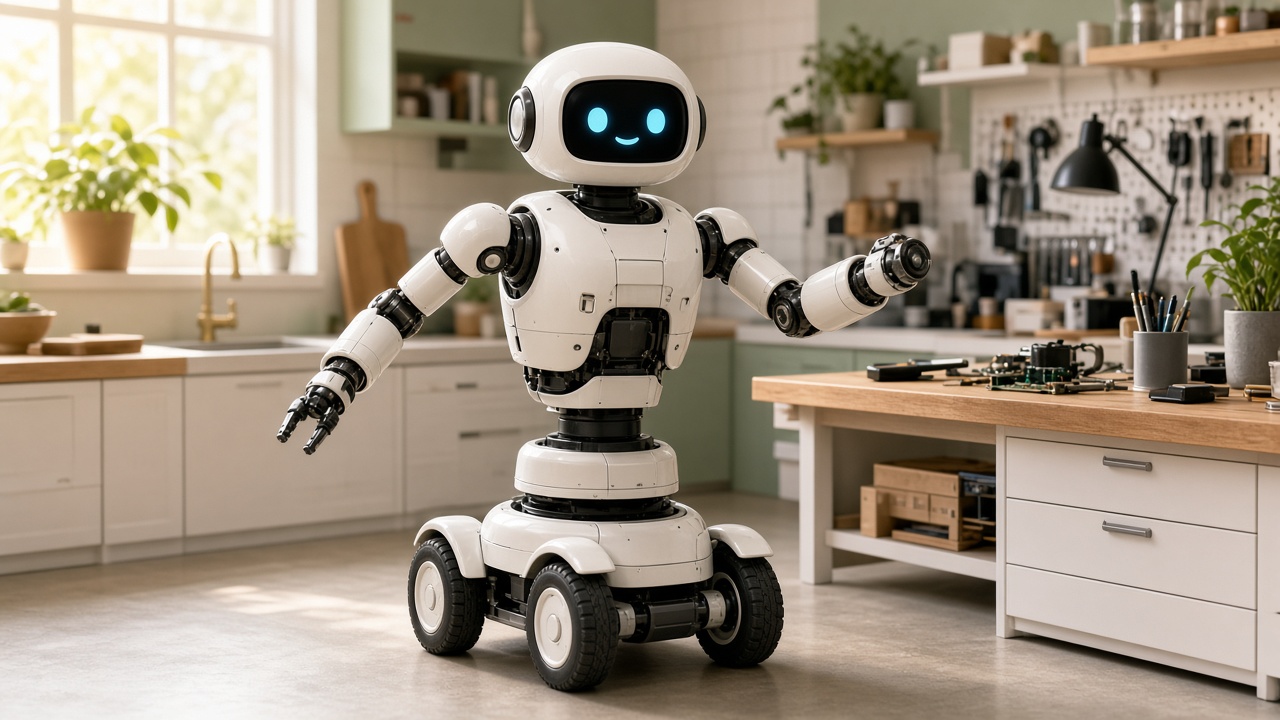
Waiting for a perfect general-purpose robot is a long queue. Feather Robotics would rather sell you a body you can program this year.
The San Francisco–area startup, covered by TechCrunch on Sept. 24, is pitching a modular wheeled “humanoid” platform starting at $29,990 — about half the price it cites for Unitree’s H2 Edu, and positioned as a U.S.-built option as some foreign models face import limits. Specs on Feather’s site include roughly 1 meter of arm reach, 600 mm of vertical torso travel, a 360° holonomic base (up to about 1.3 m/s), and dual hot-swappable batteries rated for about 10 hours.
Software is meant to be open and boring in the best way: an open Python / ROS 2 SDK, simulation support, teleoperation, and the ability to run models from leading robotics AI stacks — TechCrunch names Nvidia, Skild, and Physical Intelligence. Co-founders Hoa Mai (ex-1X path) and Parsa Bakhtiari (former Tesla Model 3 engineer) frame it as the Android of robotics: ship workable hardware now, let developers add brains and apps over time.
Gradient Ventures led a $7.6 million pre-seed. Feather says it has already passed $1 million in revenue, with field use in places like food service and science labs, and is gearing up for a larger product launch after a year of fixing field issues.
Why regular people should care
Restaurants, labs, and factories do not need a sci-fi butler on day one — they need arms that can cook, clean, or move parts without a multi-year custom robot project. A ~$30k open body lowers the cost of trying physical AI the way cheap Android phones once lowered the cost of trying apps. That can mean fewer dull or dangerous shifts for people, and faster experiments for startups that build the software layer.
It is still early hardware, not a ChatGPT moment for robots. The bet is ecosystems beat closed demos.
What’s next
Watch the “big product launch” Mai teased, named customers, and whether developer apps pile onto the SDK. If Feather becomes a common body for many brains, the interesting race shifts from who builds one robot to who ships the best jobs on top.
Sources: TechCrunch, Feather.